Map it. Prove it.
Fund it.
Archium turns one shared Excel workbook into a live enterprise architecture platform and a Treasury-grade business case — generated on load, refreshed on every save. No per-application licence. No data leaves your building unless you say so.
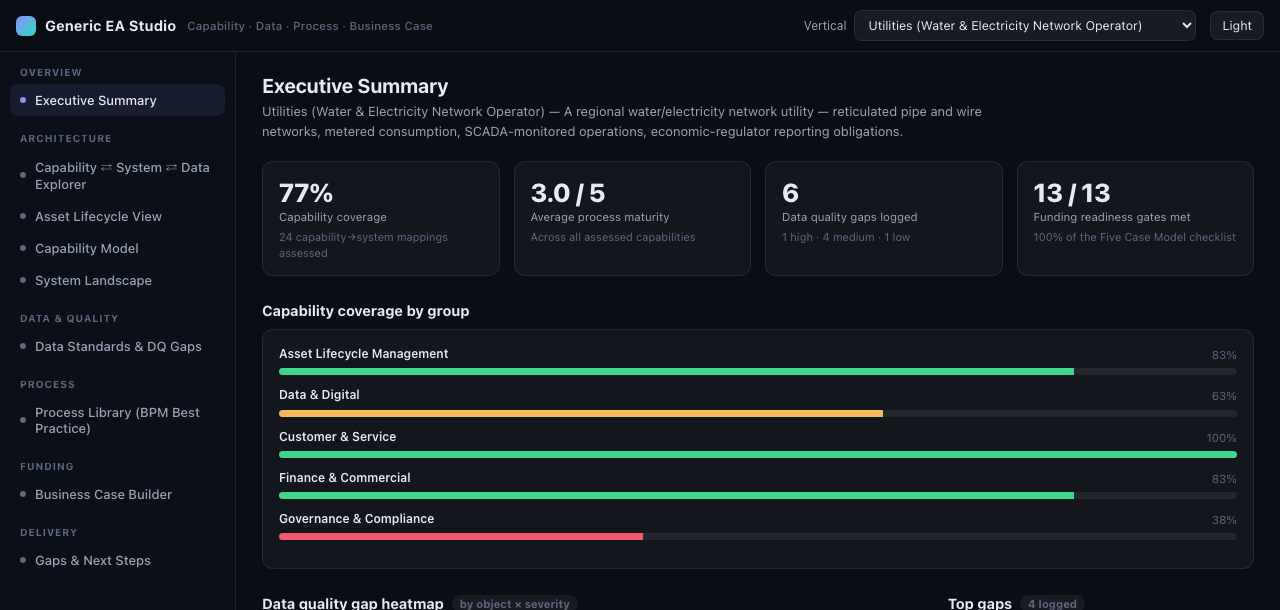
The landscape is real. Your record of it isn't.
Most organisations run their architecture the same way: a Visio diagram nobody trusts, a spreadsheet three people have a different copy of, and a business case rebuilt from scratch every funding cycle.
One published example of a single negotiated per-application EA platform deal — a 300-application portfolio. Individual deals vary.
Source: public pricing analysis, 2025TOGAF-certified practitioners worldwide — and most still assemble their business case in Word, by hand.
Source: The Open Group certification directoryMajor EA platforms whose published feature lists include a Five Case Model business case builder, as at July 2026.
Survey of vendors' published feature lists, July 2026Three steps. No server, no consultant, no six-week rollout.
Load your workbook
Fill three plain-language Excel tabs — providers, capabilities, what each system actually sends — or drag in an existing export. Drop it on the page. Everything else computes.
Explore instantly
Coverage percentages, inferred gaps, a live mind map, drill-down fact sheets, and a 13-gate business-case readiness score — all recomputed the moment the file lands, all traceable back to the row that produced them.
Export what you need
Editable draw.io diagrams, TOGAF ADM artifacts, a Five Case Model business case document, or the updated workbook itself — every output is a real, editable file, not a locked screenshot.
Everything an architecture practice actually uses, in one file.
Coverage & gap analytics
Every gap is inferred from what's missing in the data — nobody hand-tags a risk register that goes stale.
Diagram Studio
Drag-to-arrange landscape, integration and capability maps. Export editable draw.io XML, SVG or PNG.
Business Case Builder
The Five Case Model with live NPV, BCR, payback and a 13-gate readiness score that shows what a review board will flag.
TOGAF Artifact Generator
ADM phases A–H — capability catalogs, application portfolios, gap analyses — generated as editable xlsx and markdown.
Fact Sheets & Inventory
One consistent, editable page per provider, system or capability, with a completeness seal — the LeanIX pattern, without the licence.
AI Assist, on your terms
Bring your own OpenAI-compatible endpoint — including a fully local model. Redaction on by default; nothing sends without your review.
The half of the category nobody else built.
NPV, BCR and payback — computed, not eyeballed.
Strategic, Economic, Commercial, Financial and Management cases, structured to the HM Treasury Green Book Five Case Model. Every option's arithmetic is one click from the formula that produced it.
- Options appraisal with ±20% benefits sensitivity — the standard optimism-bias check
- Benefits realisation register: no owner, no baseline, no target means no benefit
- Risk and change-impact registers, seedable straight from the live landscape
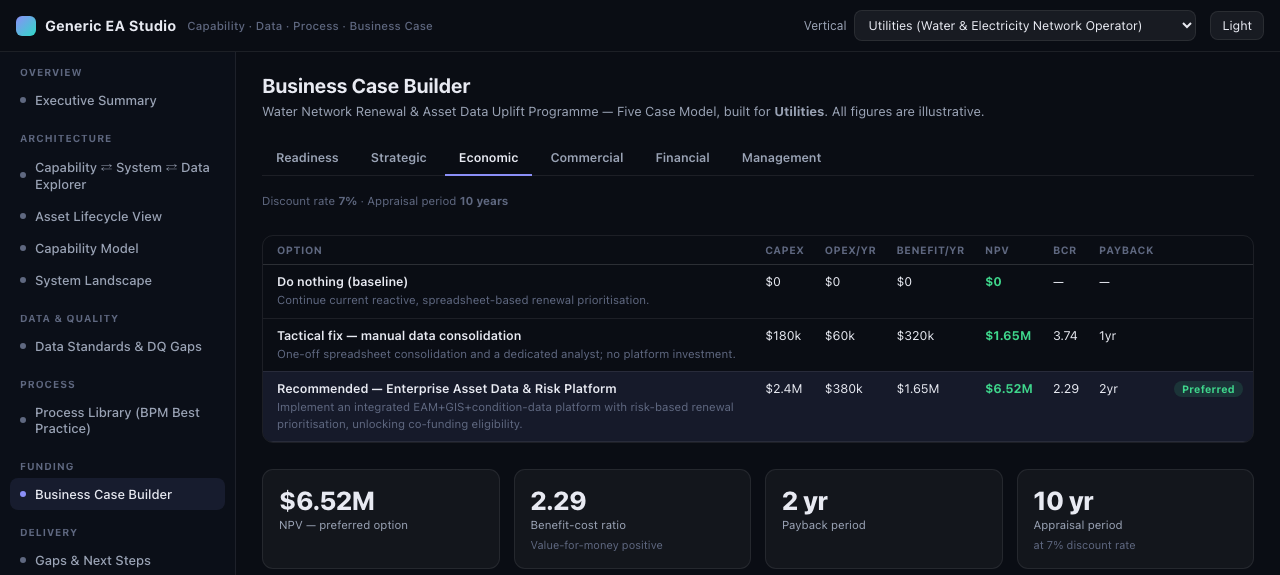
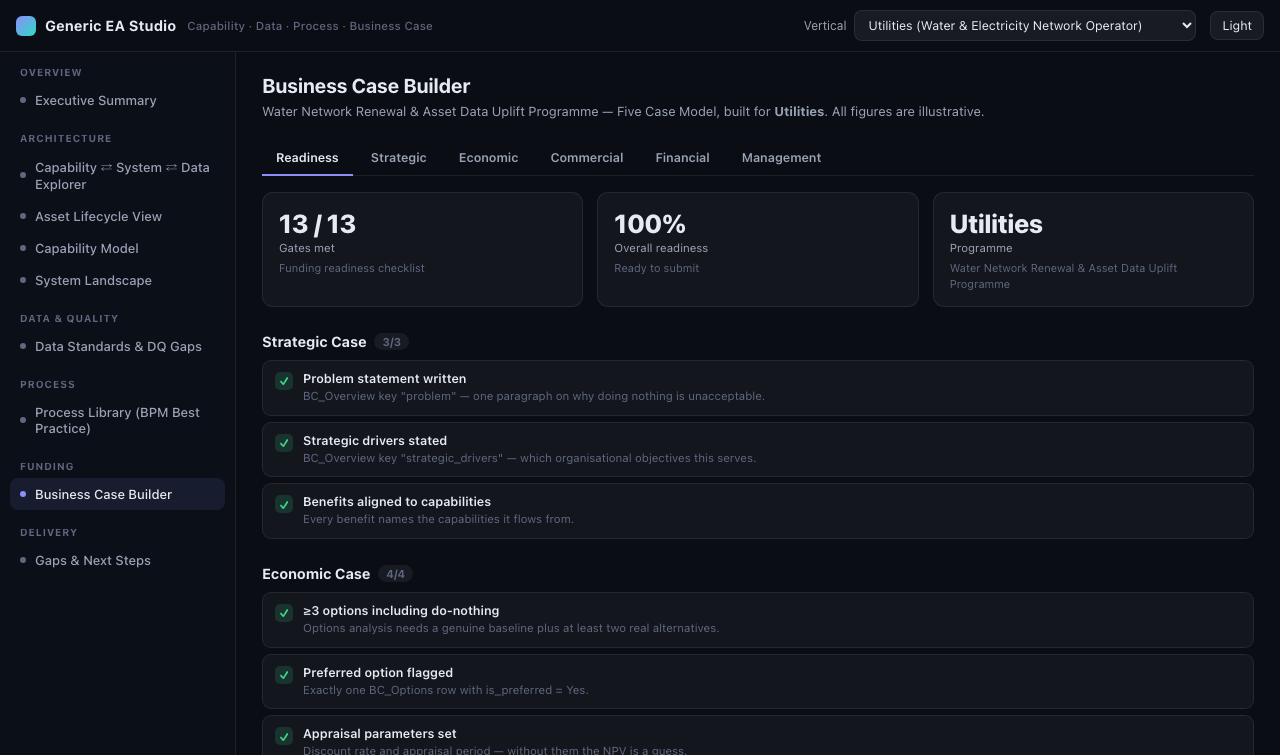
Know what the review board will flag — before they do.
13 gates across all five cases, scored live: has the problem statement been written, is a preferred option flagged, does every benefit have an owner. Ship a business case that survives Gateway review the first time.
- One click exports the full case as an editable document
- Change-impact register seeds itself from retiring and planned systems in the landscape
- The same engine that scores readiness also generates the TOGAF compliance checklist
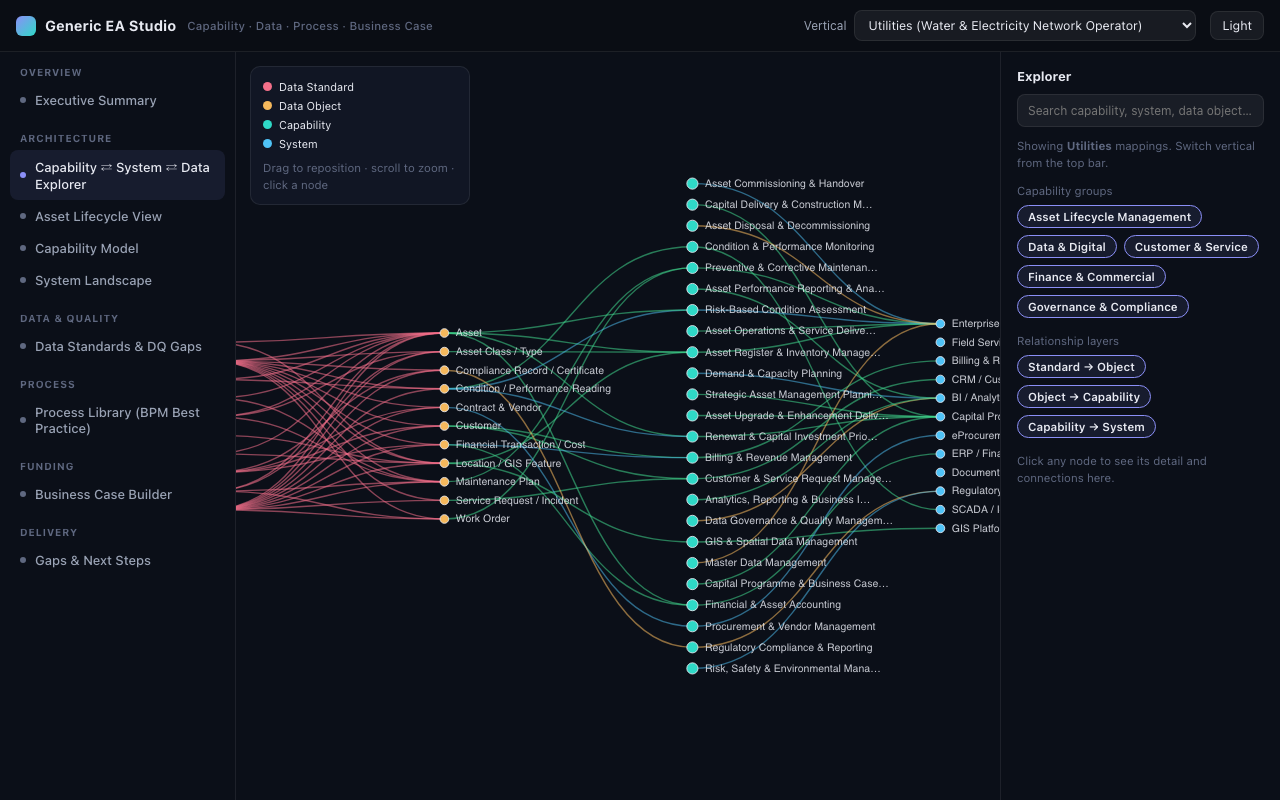
Every capability, system and data object — one graph away.
Drag any node, zoom into a cluster, click through from a data standard to the object it governs, to the capability that consumes it, to the system that runs it. The whole chain, live — not a static diagram someone drew once and forgot to update.
- Filter by capability group or relationship layer — standards, objects, capabilities, systems
- Click any node for its full detail and every connection, without leaving the graph
What would Archium be worth to you?
The same NPV formula the Business Case Builder uses on your architecture data, run here on your team's reconciliation effort. Move the sliders — nothing is sent anywhere; this runs entirely in your browser.
Illustrative, using the same annuity method as the in-product Business Case Builder: (1−(1+r)⁻ᴺ)÷r at r=7%, N=3 years. Replace with your own figures inside Archium for a defensible, auditable number.
You're not choosing between vendors. You're choosing between an hour of setup and another year of drift.
| Spreadsheets & Visio | Typical per-app EA platform | Archium | |
|---|---|---|---|
| Pricing | "Free" — hidden reconciliation cost | Scales with app count | Flat, unlimited apps & users |
| Where data lives | Scattered across owners | Vendor's cloud | Your infrastructure, self-hosted |
| Business case | Rebuilt by hand each cycle | Not on published feature lists (July 2026) | Built in — Five Case Model, live NPV |
| Gap detection | Whoever remembers to ask | Manual tagging | Inferred automatically from the data |
| Diagrams | Hand-drawn, drift within weeks | Locked to the vendor's canvas | Generated, editable draw.io export |
| AI features | None | Vendor-managed, data leaves your network | BYO endpoint, redacted by default |
| Time to first value | N/A — always "in progress" | Weeks of configuration | Minutes — drop a file on the page |
Built for any asset-intensive sector. Tested by someone who'd never seen it before.
Every foreign key resolves. Every capability has a system for every vertical. Every funding-readiness gate has evidence behind it — reconciled automatically, every time the workbook reloads.
An automated integrity suite — not a human spot-check — verifies the data model after every change: every cross-reference, every coverage gap, every funding-readiness precondition. Separately, the underlying workflow was validated in a usability test where a non-technical operations manager filled in the template cold, using only the built-in README, and was productive in under 90 minutes.
Built for the security review, not around it.
Self-hosted by default
One static file. Docker, Kubernetes, SAP BTP or your own web server — your data never touches our infrastructure because we don't have any in the loop.
AI is opt-in, always
No AI call happens without you configuring an endpoint and previewing the exact outbound text first.
Redaction by default
Provider, system and personnel names are replaced with placeholders before anything leaves your browser — mapped back to real names only on your machine.
No lock-in
Your data lives in a standard .xlsx file you already own. Stop using Archium any day and keep everything.
Priced by organisation. Never by how much you use it.
The full core product. Self-host it today.
- Unlimited users, apps & capabilities
- Coverage analytics, Mind Map, Explorer
- Business Case Builder, Diagram Studio, TOGAF generator
- Excel round-trip, dark/light themes
- Deployment support
- SLA-backed support
Deployment support and an SLA, self-serve.
- Everything in Community
- Docker / K8s / BTP deploy support
- Email support, 2-business-day SLA
- Up to 5 portfolios (roadmap)
- SSO / managed AI gateway
Your infrastructure, a named engineer.
- Everything in Pro
- Platform-layer SSO via deployment support; native SSO & managed AI gateway (roadmap)
- Dedicated Slack, 4-hour SLA
- Unlimited portfolios, executive rollup (roadmap)
- Custom TOGAF artifact templates
Items marked (roadmap) are committed but not yet shipped. Today the product has no in-app auth surface: single sign-on is delivered at the platform layer — a reverse proxy or SAP BTP approuter in front of your self-hosted instance, covered by Enterprise deployment support. AI Assist ships in every tier as bring-your-own-endpoint (including fully local models), with redaction on by default.
Frequently asked
Do I need to be technical to use this?+
Where does my data actually live?+
What happens to my data when I use the AI features?+
Can I switch from our existing spreadsheets?+
What does the "readiness score" actually check?+
How is this different from just using LeanIX or Ardoq?+
Your architecture already exists. Start showing it.
Download the Community edition, or talk to us about Enterprise deployment on your own infrastructure.